
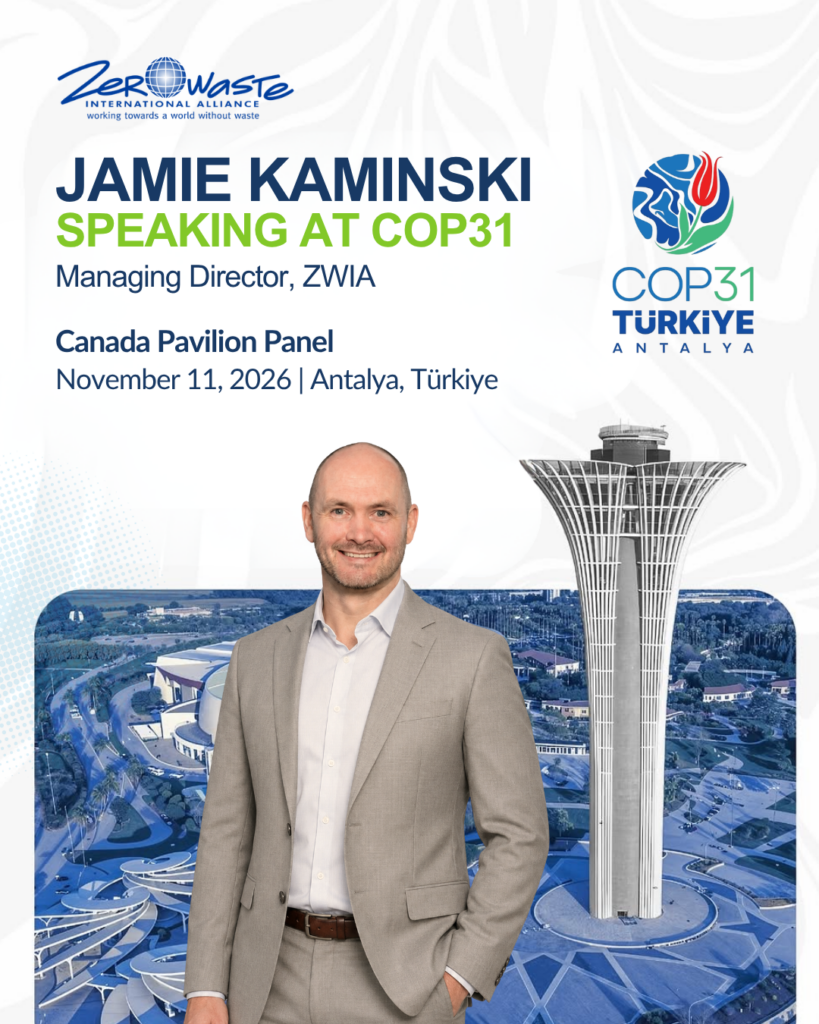
The Zero Waste International Alliance (ZWIA) will be represented at the 31st United Nations Climate Change Conference (COP31) in Antalya, Türkiye, by Managing Director Jamie Kaminski, who will join a Canada Pavilion discussion on practical solutions to plastic pollution.
The session, “Beyond Cleanup: Scaling Solutions to Plastic Pollution,” is scheduled for November 11, 2026, from 10:00 to 10:45 a.m. Antalya time, at the Canada Pavilion. It will consider which approaches are working, what holds them back and how public policy can help effective solutions grow.
In addition to the Canada Pavilion panel, Jamie has also been invited to participate with the Government of Chad’s official delegation at COP31. This separate engagement provides another opportunity for international dialogue, knowledge sharing and collaboration on Zero Waste approaches.
Through these engagements, ZWIA looks forward to contributing to international conversations about waste prevention, resource management and the policies needed to support meaningful progress.
For ZWIA, the opportunity is not simply to discuss waste after it has been generated. It is to bring more attention to the choices, systems and policies that can prevent waste in the first place.
Why Move Beyond Cleanup?
Cleanups and recovery efforts can address material that has already entered the environment. However, a lasting response to plastic pollution also needs to examine why unnecessary materials are produced, used briefly or discarded.
An upstream Zero Waste approach asks different questions: Can the product or packaging be avoided? Can it be designed to last longer? Could reuse or refill systems replace disposable formats? Can repair keep valuable materials in use? How can policies support these changes at a scale that makes a difference?
These questions are reflected in the Zero Waste Hierarchy, a framework that prioritizes prevention and responsible resource use while guiding policy and implementation. ZWIA develops and maintains internationally aligned Zero Waste guidance through collaboration with its global network.
Learn more about ZWIA’s updated Zero Waste Hierarchy: https://zwia.org/2025/06/zero-waste-international-alliance-announces-update-to-the-zero-waste-hierarchy/
ZWIA’s Participation in the COP31 Canada Pavilion
ZWIA Managing Director Jamie Kaminski will join the moderated panel “Beyond Cleanup: Scaling Solutions to Plastic Pollution” on November 11.
The discussion will be moderated by Parisa Golchoubian, Founder and CEO of Retide, and will bring together perspectives from Ocean Legacy Foundation, The Greater Good, Sungai Watch, PCX Solutions and ZWIA.
Jamie will share insights into how Zero Waste frameworks can inform practical policy and implementation, with a focus on moving upstream toward prevention, reuse and repair.
The session will explore what is already working to address plastic pollution, the barriers that prevent promising solutions from expanding and the role of policy in supporting long-term progress.
For an international network such as ZWIA, these discussions provide opportunities to connect policy thinking with the experiences of practitioners, organizations and communities addressing pollution in different contexts.
How Can Zero Waste Policies Support Solutions That Scale?
Policies can help establish common expectations, while successful programs demonstrate what is achievable in real settings.
Effective action often requires several connected elements:
- Prevention at the design and purchasing stage: Avoiding unnecessary materials before they become waste.
- Systems that make reuse practical: Supporting refill, return, repair and other approaches that keep products and materials in use.
- Clear standards and accountability: Establishing credible definitions, responsibilities and ways to assess progress.
- Local implementation capacity: Enabling communities and organizations to adapt solutions to their own conditions and priorities.
No single measure can solve plastic pollution. Progress depends on aligning policies, markets, operational systems and community participation.
The experiences shared during COP31 can help strengthen understanding of how these elements work together and how Zero Waste principles can contribute to broader climate and environmental goals.
International Collaboration: Engagement With the Government of Chad’s Delegation
In addition to the Canada Pavilion discussion, Jamie has been invited to participate with the Government of Chad’s official delegation at COP31. This engagement is separate from the November 11 panel.
This opportunity reflects the importance of connecting international Zero Waste knowledge with the priorities and experiences of different countries and communities. Through dialogue and collaboration, ZWIA hopes to exchange perspectives on practical approaches to waste prevention, resource management and sustainable systems.
Further information about Jamie’s participation with the delegation will be shared as details are confirmed.
Connecting International Learning With Action
ZWIA’s work is rooted in a collaborative international community of national affiliates, working groups, advocates and practitioners.
Through participation in the Canada Pavilion discussion and engagement with the Government of Chad’s delegation, ZWIA looks forward to contributing its perspectives while learning from the experiences and priorities of others.
COP31 presents an opportunity to strengthen international relationships, exchange practical knowledge and bring greater attention to the role of prevention, reuse and repair in addressing plastic pollution and resource consumption.
The next step is to turn promising ideas into credible policies and practical systems that can be understood, applied and improved in different communities around the world.
ZWIA looks forward to continuing these conversations and sharing relevant insights with the international Zero Waste community following COP31.
Learn more about COP31:
- COP31 Türkiye: https://cop.sifiratikvakfi.org/en/
- UN Climate Change: https://unfccc.int/cop31
Follow ZWIA for further updates on its participation and international Zero Waste initiatives.
Frequently Asked Questions
When and where will Jamie Kaminski speak at COP31?
Jamie Kaminski will participate in the Canada Pavilion panel, “Beyond Cleanup: Scaling Solutions to Plastic Pollution,” on November 11, 2026, from 10:00 to 10:45 a.m. local time in Antalya, Türkiye.
What is ZWIA’s role in the Canada Pavilion discussion?
Jamie will participate as Managing Director of the Zero Waste International Alliance. He will contribute perspectives on Zero Waste policy, prevention, reuse, repair and the practical systems needed to support scalable solutions.
Is Jamie Kaminski also participating with the Government of Chad’s delegation?
Yes. Jamie has also been invited to participate with the Government of Chad’s official delegation at COP31. This is a separate engagement from the Canada Pavilion panel, and additional details will be shared when confirmed.
What is an upstream Zero Waste approach?
An upstream Zero Waste approach prioritizes preventing waste before it is created. It includes avoiding unnecessary materials, improving product design and encouraging reuse, refill and repair systems to keep products and resources in use for longer.